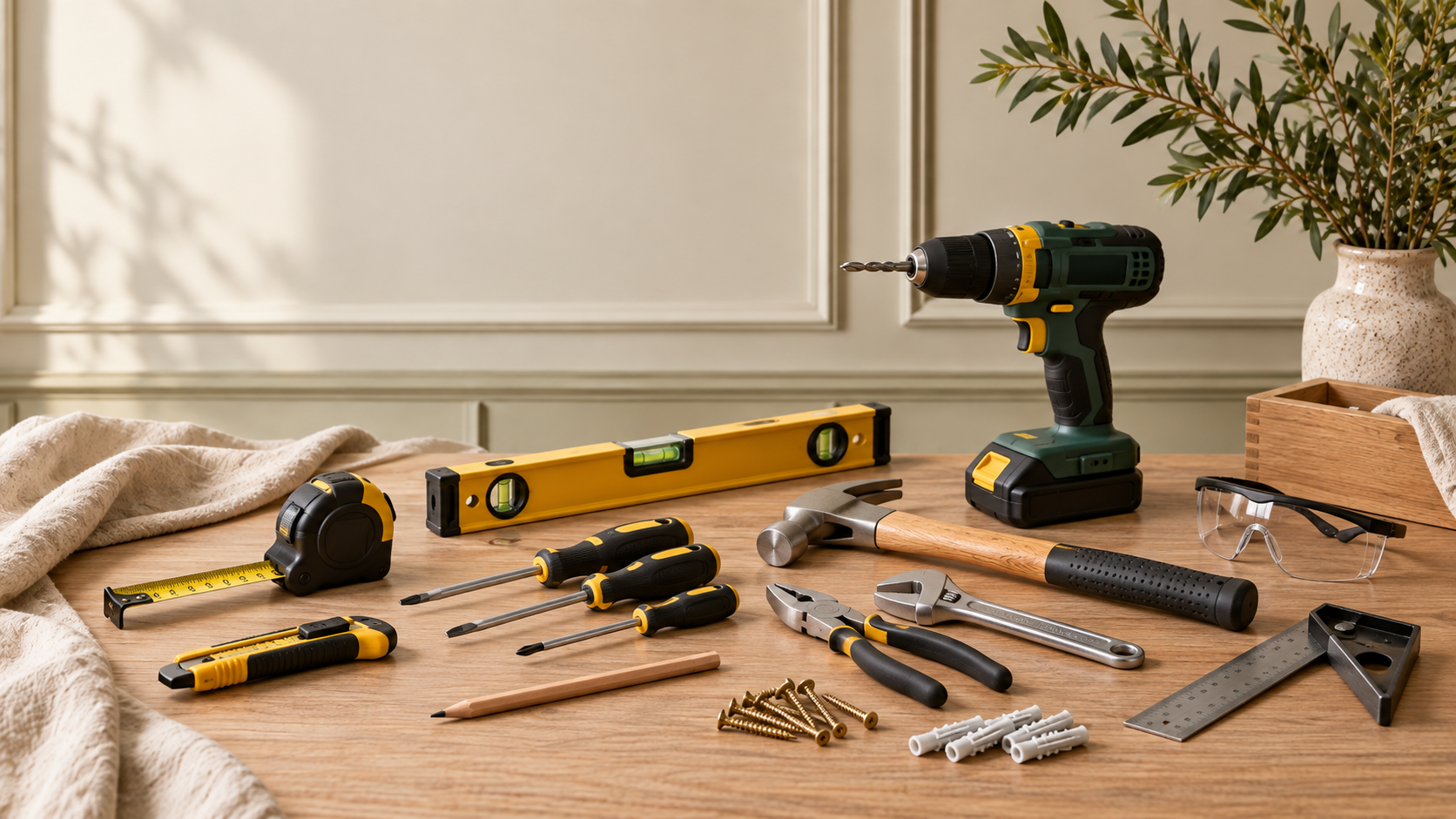
You do not need a workshop full of tools to start DIY. You need a small number of reliable basics, the right drill bits and fixings for the material in front of you, and permission to buy the specialist thing only when the project earns it.
Our rule is simple: buy the tools you will reach for repeatedly, hire or borrow expensive specialist kit, and do not confuse owning equipment with knowing how to use it.
A good first toolkit should let you measure, mark, tighten, drill, cut, level, fill, sand and protect yourself. That covers an enormous amount of everyday DIY.
Tools
What you’ll need to do the job.
- 5m tape measure
- Pencil and permanent marker
- Medium spirit level
- Cordless drill/driver
- Mixed drill bit set for timber, metal and masonry as required
- Driver bit set
- Claw hammer
- Screwdriver set
- Pliers and adjustable spanner
- Retractable utility knife
- General purpose hand saw
- Combination square
- Filling knife
- Caulking gun
- Small set of clamps
- Torch or head torch
- Pipe, cable and stud detector
- Toolbox or organised storage
Materials
What you’ll need to build it.
- A small selection of screws
- Fixings matched to common wall types in your home
- Sandpaper in a few grades
- Decorators caulk
- General purpose filler
- Masking tape
- Pencils and spare blades
- Eye protection
- Hearing protection where required
- Dust masks/respiratory protection appropriate to the task
- Work gloves appropriate to the task
Step by step
Do it in this order.
Start with measuring and marking
Most DIY errors start before the cut. A reliable tape, pencil, square and level are more valuable than a cupboard full of specialist gadgets.
Buy one sensible drill platform
For many homes, a cordless combi drill or drill/driver becomes the most used power tool. Choose a battery platform you can add to later rather than buying isolated tools with incompatible batteries.
Learn drill bits before buying more power tools
Timber, metal and masonry need different bits and settings. The right bit in an ordinary drill often matters more than buying a bigger drill.
Build a small hand tool core
Hammer, screwdrivers, pliers, adjustable spanner, knife, saw and filling knife cover repairs, flat pack, basic carpentry, decorating prep and dozens of small jobs.
Add a detector and PPE early
A detector is not glamorous, but it should be part of your routine before drilling into walls. Eye, hearing and dust protection should live with the tools, not somewhere else in the house.
Let projects decide the next purchase
Need to fit skirting repeatedly? A mitre saw may earn its place. Need one tile cut? Hire or use a manual cutter. Buy specialist tools when repeated use justifies them.
Things we’d do
Small choices that make the job better.
- Write the purchase date on batteries and keep chargers together.
- Label drill bit boxes so you know which material they are for.
- A cheap tool you fight every time is often more expensive than one decent version you use for years.
- Do not buy a 100 piece kit just because the number is big. Many contain filler pieces you will never touch.
Things we wouldn’t
Common shortcuts that usually cost you later.
- Buying multiple cordless brands before you know which battery platform suits you.
- Using the wrong wall plug because it happens to fit the screw.
- Drilling before checking for hidden services.
- Buying specialist tools for one job when hire makes more sense.
Before you start
Know where DIY stops.
- Read the tool manual and use the guards and safety features provided.
- Match PPE to the actual hazard: dust, noise, flying debris, sharp materials or chemicals.
- Do not use powered equipment if you are unsure how to operate it safely.